
Abstract
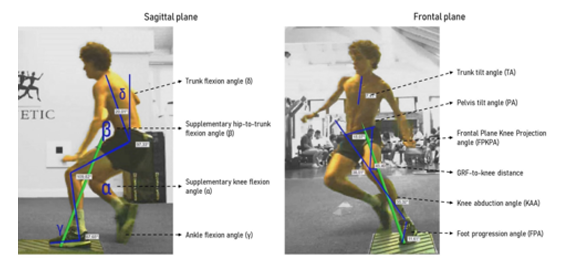
Anterior cruciate ligament (ACL) rupture remains a leading cause of long-term absence in football and is frequently triggered by sub-optimal mechanics during rapid change-of-direction (COD) manoeuvres. To transform laboratory motion analyses into actionable field feedback, a three-stage pipeline is presented. First, 45 kinematic and kinetic variables recorded from 1,009 youth footballers during COD tests are embedded with t-SNE and clustered by agglomerative clustering (Euclidean distance, Ward linkage), revealing four force-and-control phenotypes aligned with established ACL-risk mechanisms. Second, a Random-Forest classifier recreates these phenotypes from a set of 12 features selected for both importance and ease of capture, achieving a macro-averaged F1 = 0.85 (compared with 0.92 when all 45 variables are used). Third, the classifier is wrapped in a General Data Protection Regulation (GDPR) compliant application that accepts the 12 inputs, instantly assigns the athlete’s phenotype, and displays tailored exercise cues. The pipeline demonstrates that laboratory-grade biomechanics can be condensed into a rapid, interpretable decision-support tool, enabling data-driven ACL injury mitigation in routine sports medicine practice.